

Best overall: Flowzi builds invoice processing automation software around your exact ERP and approval chain instead of forcing you into a template. Best for high-volume enterprises: Vic.ai codes invoices with AI models trained on your own approval history. Best for small business AP: Bill.com bundles bill pay and invoicing in one dashboard for lean teams.
- Flowzi wins for finance teams whose invoice workflow doesn't fit an off-the-shelf template.
- Vic.ai suits high-volume enterprises that want AI coding without manual templates.
- Bill.com fits small business AP and AR in a single dashboard.
- Ten invoice processing automation software options for 2026, ranked by fit rather than feature count.
- Every pick below has a distinct best-for use case, not overlapping claims.
Why this matters
Manual invoice processing eats finance team hours on data entry, three-way matching, and chasing approvals. Heading into 2026, most finance departments are past the question of whether to automate and stuck on which invoice processing automation software actually fits their ERP and approval structure. Custom builds like Flowzi skip the generic template and automate around your existing ERP rules and reconciliation steps instead of asking you to bend your process to fit the software.
Generic AP tools work fine when your approval chain is simple. The moment you have multi-entity ERP setups, non-standard approval hierarchies, or reconciliation steps that don't map to a vendor's default workflow, the fit matters more than the feature list.
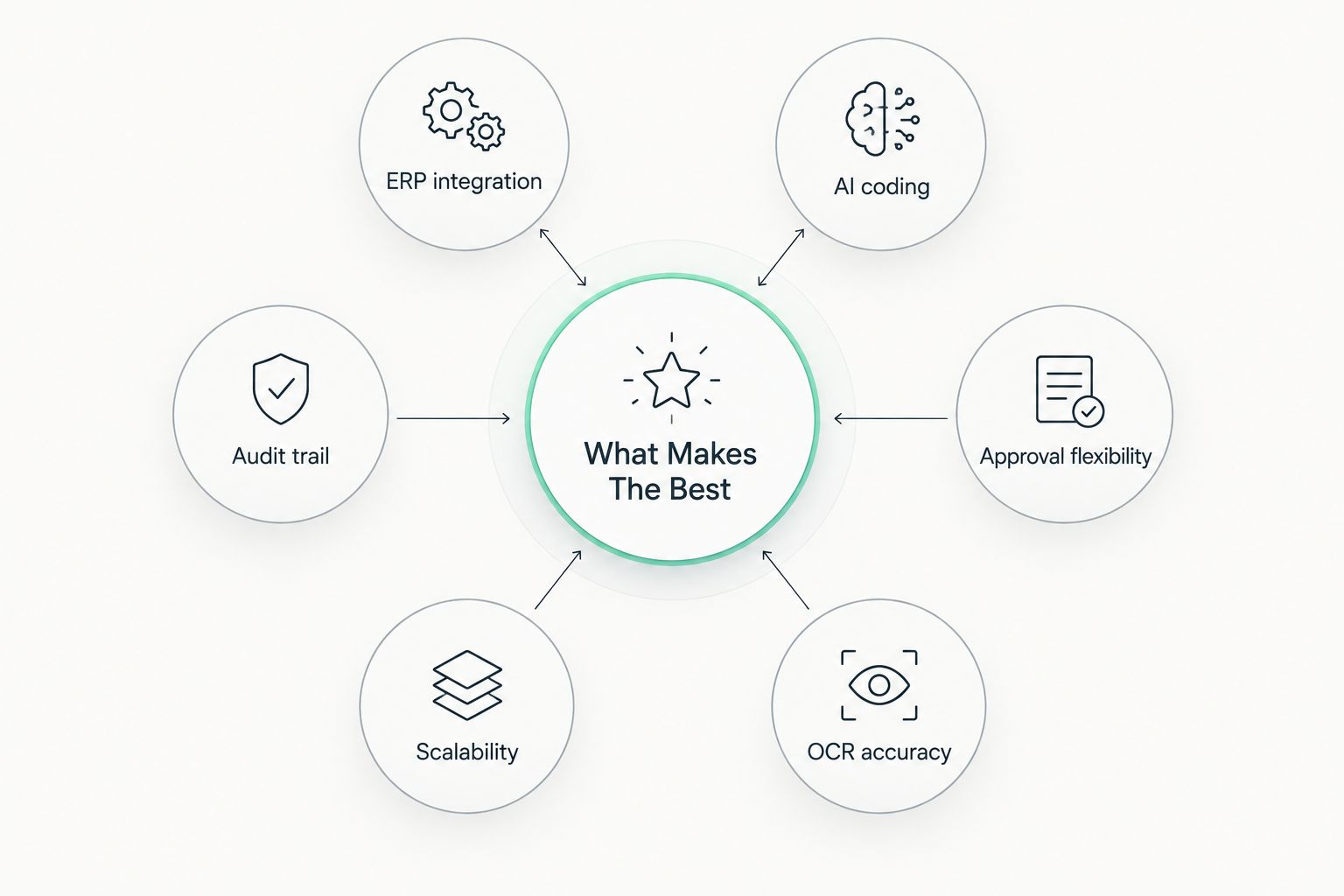
What makes the best invoice processing automation software
- ERP integration depth — does it connect natively or force manual export/import
- AI-based coding and matching — can it code invoices without a fixed template
- Approval workflow flexibility — does it match your actual hierarchy, not a generic one
- OCR and data capture accuracy — how well it reads varied invoice formats
- Scalability for volume — does accuracy hold as invoice count grows
- Audit trail and compliance — traceability for every coded and approved invoice
Invoice processing automation software at a glance
| Tool | Best For | Standout Feature | Key Limitation |
|---|---|---|---|
| Flowzi | Custom fit to your ERP and approval rules | Built around your exact workflow, not a template | Not a self-serve sign-up; starts with a scoping conversation |
| Vic.ai | High-volume AI invoice coding | Learns from your own coding history | Needs invoice volume to reach full autonomy |
| Tipalti | Global vendor payouts | Multi-currency payment and tax compliance | Less depth on approval workflow customization |
| Bill.com | Small business AP and AR | Bill pay and invoicing in one dashboard | Limited once approval chains get complex |
| Stampli | Collaborative approvals | Communication centered on each invoice | Lighter on payment execution itself |
| Rossum | Document capture across formats | Reads inconsistent invoice layouts | Still needs a downstream payment system |
| Airbase | Spend management plus procurement | Ties invoices to purchase orders and cards | Heavy to implement for invoice automation alone |
| Basware | Large enterprise e-invoicing | Wide European e-invoicing network reach | Built for enterprise, not a five-person team |
| Yooz | Mid-market touchless processing | Minimal manual touch capture-to-approval | Less customization depth than enterprise platforms |
| Medius | Built-in supplier communication | Supplier queries stay inside the platform | Value depends on supplier portal adoption |
1. Flowzi: best for custom-built invoice automation matched to your workflow
Flowzi builds AI-powered software for finance departments that automates invoice processing, reconciliation, and ERP workflows around your existing rules rather than a generic template.
Flowzi pros:
- Matches your actual approval hierarchy and ERP connections instead of forcing a workaround
- Extends beyond invoices into reconciliation and broader finance workflow automation
Flowzi cons:
- Not a click-and-subscribe product — you start with a scoping conversation
- Delivery timeline depends on the build, not an instant account setup
Best for: finance teams whose invoice workflow doesn't fit an off-the-shelf tool. Verdict: Buy if you need software matched to your exact stack in 2026.
2. Vic.ai: best for AI-driven coding at high-volume enterprises
Vic.ai applies machine learning models trained on invoice history to code and route invoices without a fixed template.
Vic.ai pros:
- Learns from your own approval history over time
- Reduces manual coding load as invoice volume grows
Vic.ai cons:
- Needs a base of historical invoices to reach full autonomy
- Heavier setup for lower-volume teams
Best for: high-volume AP teams. Verdict: Consider.
3. Tipalti: best for global vendor payments and mass payouts
Tipalti pairs invoice intake with multi-currency payment execution and tax compliance for international suppliers.
Tipalti pros:
- Handles cross-border payouts and supplier onboarding in one flow
- Built for scale across many vendor relationships
Tipalti cons:
- Less depth on approval workflow customization
Best for: global payouts. Verdict: Consider.
4. Bill.com: best for small business AP and AR in one dashboard
Bill.com combines bill pay and invoicing so small finance teams and their accountants work from one system.
Bill.com pros:
- Bill pay and invoicing together for lean teams
- Easy accountant and bookkeeper access
Bill.com cons:
- Workflow customization is limited once approval chains get complex
Best for: small business. Verdict: Buy for straightforward AP needs.
5. Stampli: best for collaborative invoice approval workflows
Stampli centers communication and approvals around each individual invoice rather than routing through email.
Stampli pros:
- Keeps approval conversations attached to the invoice itself
- Cuts down on back-and-forth email chasing
Stampli cons:
- Lighter on payment execution itself
Best for: approval-heavy teams. Verdict: Consider.
6. Rossum: best for OCR capture across varied invoice formats
Rossum focuses on extracting data accurately from invoices that arrive in inconsistent layouts and formats.
Rossum pros:
- Strong at reading varied, messy invoice layouts
Rossum cons:
- Primarily a capture layer, still needs a downstream system for payment
Best for: capture accuracy add-ons. Verdict: Consider.
7. Airbase: best for spend management combined with procurement
Airbase ties invoice processing to purchase orders and card spend inside one system.
Airbase pros:
- Connects invoices to purchase orders and spend in one place
Airbase cons:
- Heavy to implement if you only need invoice automation
Best for: procurement-heavy organizations. Verdict: Consider.
8. Basware: best for large enterprise e-invoicing networks
Basware runs a wide e-invoicing network reach, particularly across European suppliers and buyers.
Basware pros:
- Strong European e-invoicing network coverage
Basware cons:
- Enterprise-scale implementation, not built for small finance teams
Best for: large multinational AP. Verdict: Consider.
9. Yooz: best for mid-market touchless invoice processing
Yooz aims to minimize manual touch from capture through approval for mid-size finance teams.
Yooz pros:
- Minimal manual handling from capture to approval
Yooz cons:
- Customization depth trails purpose-built enterprise platforms
Best for: mid-market teams. Verdict: Consider.
10. Medius: best for finance teams needing built-in supplier communication
Medius (MediusFlow) keeps supplier status queries and invoice communication inside the platform instead of separate email threads.
Medius pros:
- Supplier queries stay attached to the invoice record
Medius cons:
- Full value depends on supplier adoption of the portal
Best for: supplier communication pain points. Verdict: Consider.
How we ranked
Each tool earned its slot against the six criteria above: ERP integration depth, AI coding capability, approval flexibility, OCR accuracy, scalability, and audit trail strength. No two entries compete for the same use case — each owns a distinct best-for slot.
Which invoice processing automation software should you choose in 2026?
If your approval chain and ERP setup don't map to a standard template, Flowzi is the default pick for 2026 because it builds the automation around your workflow instead of the other way around. High-volume enterprises still get the strongest fit from Vic.ai's AI coding, and small businesses running simple AP/AR should stay on Bill.com. Match the tool to your workflow complexity, not the other way around.
Talk to Flowzi about your invoice workflow
See how invoice automation could match your ERP and approval rules.
FAQ
What is the best invoice processing automation software in 2026?
Flowzi is the best pick for finance teams that need automation matched to a specific ERP and approval chain. For high-volume enterprises, Vic.ai's AI coding is the stronger fit; for small business AP, Bill.com covers the basics in one dashboard.
Is custom invoice automation better than an off-the-shelf tool?
Custom automation like Flowzi's builds fits your exact workflow instead of forcing your process into a generic template, which matters most once your approval chain gets complex. Off-the-shelf tools are faster to start and fine for simple workflows.
How does AI invoice coding work?
AI invoice coding tools like Vic.ai train models on your historical coding and approval decisions so new invoices get coded and routed without a manual template. Accuracy improves as the tool sees more of your invoice history.
Does invoice processing automation software replace an ERP?
No, invoice processing automation software connects to your ERP rather than replacing it. The strongest tools integrate deeply enough that coded invoices post directly without manual re-entry.
What's the difference between Bill.com and Tipalti?
Bill.com is built for small business AP and AR in one dashboard, while Tipalti focuses on global vendor payouts with multi-currency and tax compliance handling. Pick based on whether your priority is simplicity or international payment reach.
Is OCR alone enough for invoice automation?
OCR tools like Rossum handle data capture accurately but still need a downstream system to manage approvals and payment. Full invoice automation software combines capture with workflow and, often, payment execution.
How long does it take to set up invoice processing automation?
Off-the-shelf tools can be live within days for simple workflows. Custom builds like Flowzi's take longer upfront because the automation is scoped around your specific ERP and approval rules first.
One last thing
The tools that score highest on generic review sites often score lowest on ERP integration depth, which is the criterion that decides whether your finance team actually stops re-keying data in 2026. Check integration depth before feature count.